November 20–22, 2026
Tournament Organizer & Judge Report — Mark Mason
My usual definition of a good event is one that stays off Reddit. By that metric, our final NRG Series weekend of the 2026 regular season was a failure. We made it onto Reddit twice!
And yet, I haven’t had this much fun at an event in over a year.
Our November excursion to Elmhurst featured:
- Four trading card games
- The culmination of a season-long Player of the Year race
- A judge conference
- Some technological growing pains, and
- A rather delightful opportunity for me to spend a significant portion of the weekend judging a game other than Magic: The Gathering.
Friday — Getting Everyone on the Same P.A.I.J.
Friday evening featured a judge conference that was very much a collaborative effort between NRGEvents.gg and Judge Foundry. With somewhere between 23 and 29 people in attendance, representation from Judge Foundry included a board member and two regional advocates.
The primary focus of the conference was judge recruitment, particularly as the opportunities to judge games other than Magic continue to grow.
Liam Shannon gave a presentation on the lifestyle of being a Judging Side Hustle Superstar. Judging can be a hobby, a supplemental source of income, an opportunity to travel, and a means of participating in communities that one might otherwise never encounter.
My presentation focused on how to give a judge call, irrespective of the game being played.
I started by informing attendees that I was a master misspeller and that I wanted everyone to be on the same P.A.I.J.
The P.A.I.J. Method
P — Preparation
There is a considerable amount of judging that happens before a player ever raises their hand. Preparation includes familiarizing oneself with the game’s rules, tournament policies, event structure, and the expectations of TO’s, Team Leads, and the Head Judge.
Preparation is showing up ready with the right information and the current versions.
A — Approaching the Call
How we approach players matters. Our demeanor, positioning, introduction, and initial questions can all influence the quality of the information we receive and the experience players have with us.
A judge arriving at a table should be a welcome development for the players.
I — Identification
Identify what kind of call this is. Are the players asking a rules question? Has a gameplay error occurred? Is there a tournament procedure issue? Or is this just a request to go to the bathroom?
If there is an infraction, identify it, along with the prescribed penalty and any applicable remedy. These are related but distinct components of a ruling.
J — Judgement
Finally, we have to deliver the ruling. However, I chose the word judgement rather than simply judge call because there is another important component here: discernment.
Is there more to the story? Is this an infraction that warrants further investigation? Is an upgrade appropriate? Would this be a good opportunity to consult another judge or mentor?
Knowing when we need additional information or assistance is itself an important judging skill.
As it would happen, the weekend would provide several rather convenient examples of why that last component matters.
Breaking Out of Magic or Breaking Into Magic!
Following the main presentations, we broke into four groups, each focused on a different game:
- Magic: The Gathering — Khailyn
- Riftbound — Brook
- Cyberpunk TCG — Liam, an Australian judge currently on this side of the pond
- Neuroscape — Yours truly
I had four participants in my Neuroscape breakout session, where we discussed getting started as a Neuroscape judge.
One of the things I particularly enjoy about the current proliferation of trading card games is the opportunity for experienced tournament officials to bring their existing skill sets to new communities. Knowing the Comprehensive Rules of a particular game is only one component of being a good judge. Many of the skills that make a person a good Magic judge are readily transferable.
There are also opportunities here for people who have never judged Magic and may never have any inclination to do so.
Saturday & Sunday — Four Games, One Ballroom
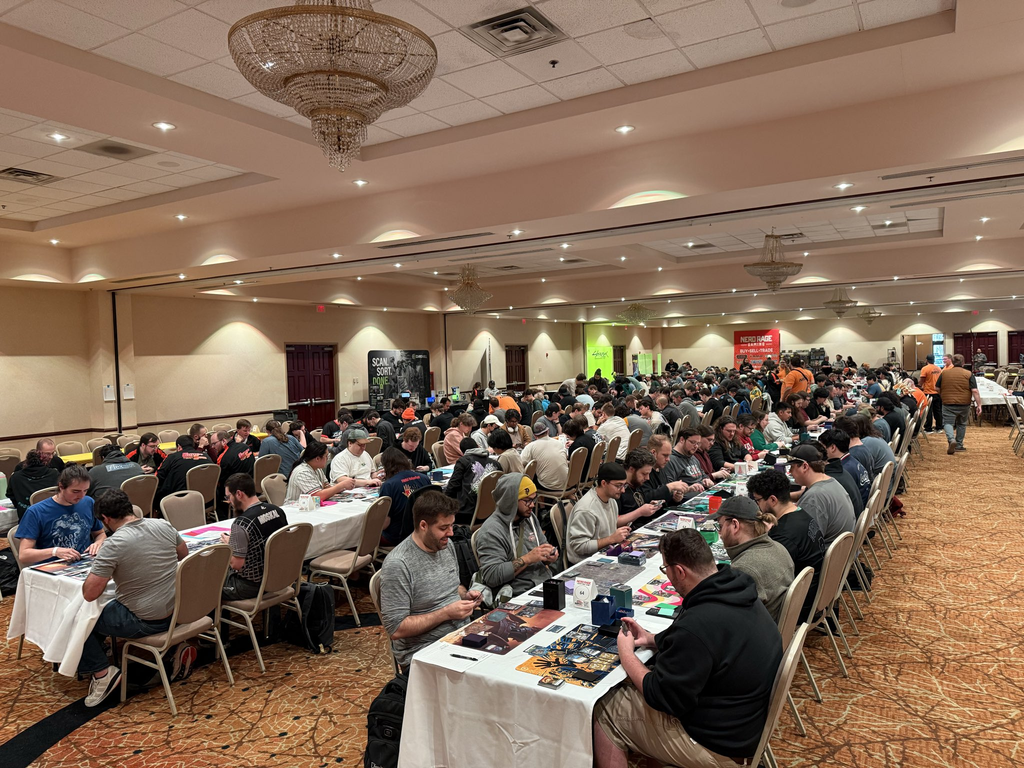
Our final regular-season NRG weekend featured Magic: The Gathering, Riftbound, Cyberpunk TCG, and Neuroscape.
Main Events
| Event | Enrollments |
|---|---|
| Saturday — Magic $10K Reality Fracture Sealed Team Trios | 58 teams / 174 players |
| Saturday — Riftbound $5K Showdown | 84 |
| Saturday — Cyberpunk $1K Night City Showdown | 31 |
| Saturday — Neuroscape $1K Corpo Comeback | 19 |
| Sunday — Riftbound $5K 2v2 Showdown | 14 teams / 28 players |
| Sunday — Magic $2.5K Pioneer Trial | 60 |
| Sunday — Magic $2.5K Standard Trial | 41 |
| Sunday — Cyberpunk $1K Night City Showdown | 19 |
In addition to our main events, NRGEvents.gg launched ten scheduled side events, including several Regional Championship Qualifiers, Win-a-Sheet events, and Sunday’s Neuroscape Corpo Teamwork Trust Fall, which attracted four teams of two.
Across these eighteen events, our enrollment figures represented 534 individual player entries. This is, of course, not a unique attendance figure, as many players participated in multiple events over the course of the weekend.
A Little Teamwork Goes a Long Way
Saturday’s $10K Magic Showdown featured Reality Fracture Team Sealed, with 58 teams representing 174 players.
We also had the opportunity to bring Team Draft back into the elimination portion of the tournament. Team Limited is a particularly enjoyable way to experience competitive Magic, and having a Team Draft elimination stage provides something considerably different from simply playing additional rounds with one’s Sealed decks.
A Horse Race to the Finish
One of the more satisfying competitive storylines of the weekend was the culmination of our 2026 NRG Series Player of the Year race.
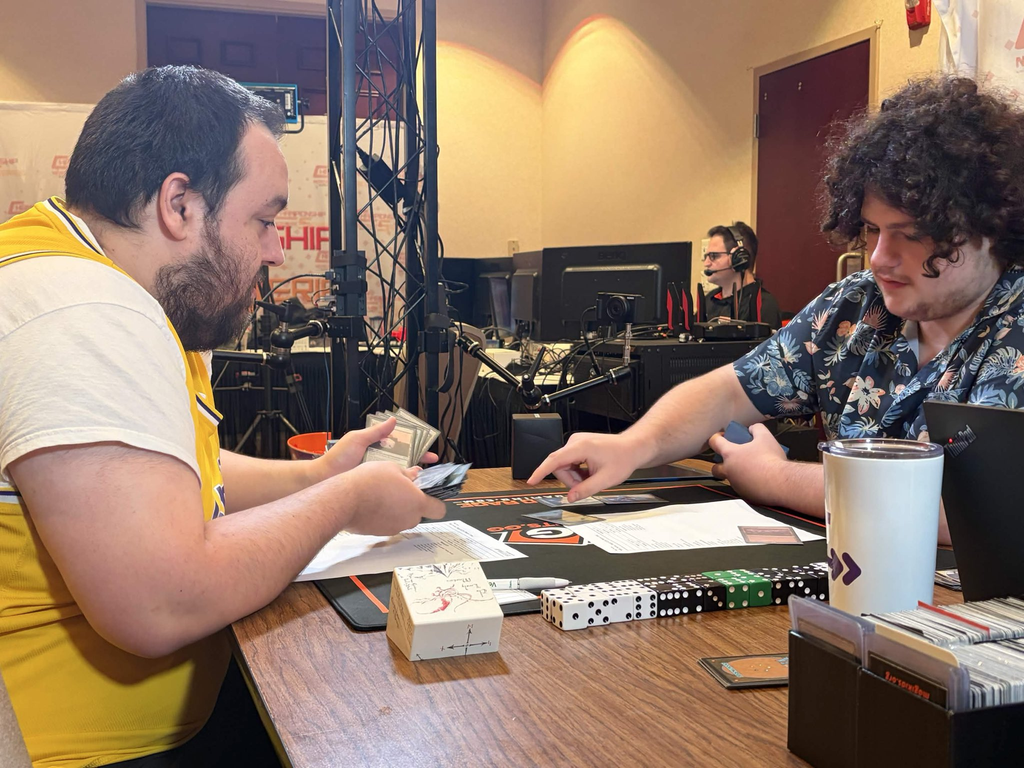
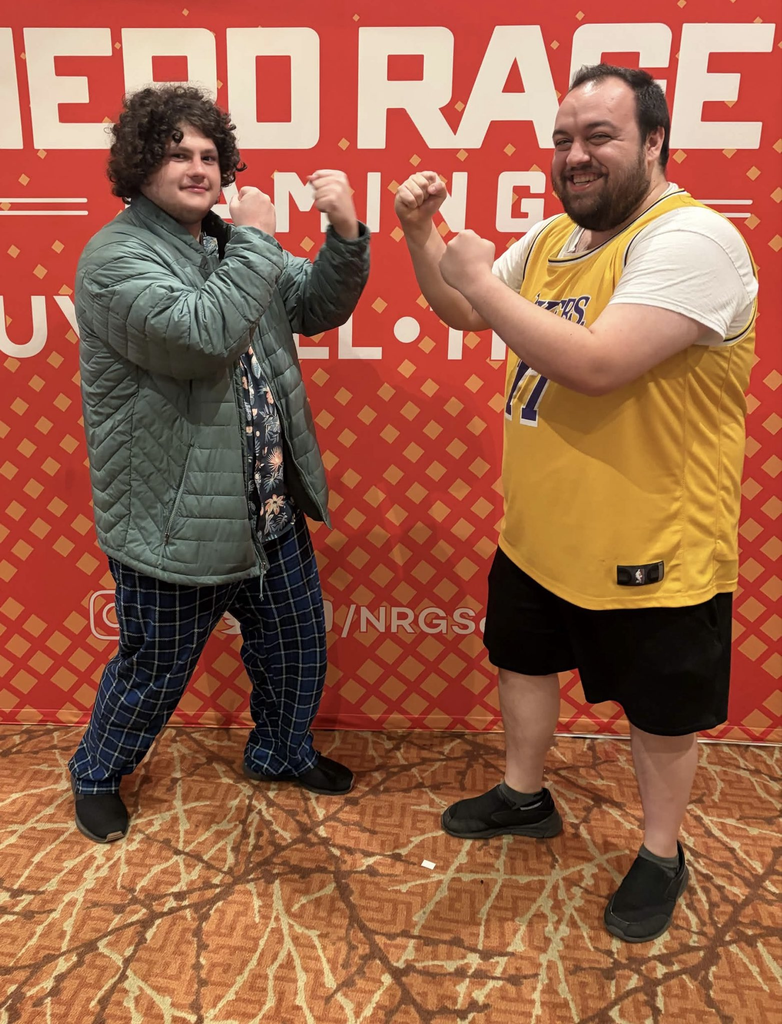
Sunday’s Pioneer Trial finals featured Pierre Smith and Tai Tajalli, both of whom were contenders for the title.
It is difficult to manufacture a better conclusion to a season-long leaderboard competition than having two of the contenders sitting across from each other in the final match of the final Trial.
Tai, playing Mono-White Humans, won the match, the Trial, and secured his position as Player of the Year.
For those interested in what people were playing on Sunday, the decklists are available on Melee:
A Rift in the Software
One of our more significant operational challenges of the weekend involved Riftbound’s new tournament software.
Saturday represented an opportunity to use Riot’s new software following the transition. Unfortunately, the software was sufficiently buggy the scorekeepers were unable to use it to successfully administer the tournament.
The scorekeepers ultimately rebuilt the event in Melee.gg.
This sort of thing has a considerable impact on an event. Tournament software is the infrastructure through which we communicate pairings, collect results, maintain standings, and move hundreds of players through a competitive experience. When that infrastructure fails, tournament staff have to reconstruct quite a bit of their work while players are already in the room expecting to play. And Riftbound is already a game with long rounds.
I do want to give considerable credit to the Riftbound programming team. They were highly responsive to the issues we encountered on Saturday, and many of those issues had been addressed by Sunday.
We were looking forward to giving the software another opportunity.
And then, somewhat amusingly and somewhat catastrophically, we broke it.
Our scorekeeper, while preparing the Sunday tournament, failed to hit the appropriate button to skip the check-in process. This resulted in the removal of all the players who had not checked in through the software.
Off to Melee.gg we went again!
While Saturday’s problems were technological in nature, Sunday’s problem was an operator error.
One of the challenges in introducing new tournament software is that we are simultaneously testing the software’s functionality and our own familiarity with its workflows. Both are potential points of failure.
On Demand, Without the Demand
NRGEvents.gg has a new tool designed to facilitate On-Demand Events. I was looking forward to getting some meaningful information about how players would interact with it in a live tournament environment.
We got no such information.
Despite inviting people to give the tool a try, we never really achieved the critical mass necessary to make it happen.
I suspect there were two significant contributors. The overall size of the event, combined with a fairly robust offering of scheduled side events, meant that there wasn’t necessarily a large enough population of players simultaneously looking for something else to do.
The other issue was simply the newness of the tool itself.
We sometimes make the mistake of assuming that providing a technological solution to a problem will result in people immediately incorporating that solution into their behavior.
Going forward, we’re going to need to expend more effort educating players about the tool, encouraging its use, and helping create those initial experiences that will make them comfortable using it independently.
It Takes a Village to Teach a TCG
Throughout the weekend, we had fairly robust Learn to Play opportunities for three of our four games: Cyberpunk TCG, Riftbound, and Neuroscape.
Neuroscape was particularly interesting because we didn’t have a dedicated Learn to Play person for the weekend.
I was the primary person doing demonstrations in the mornings before our Neuroscape tournaments started. Once the tournaments were underway, however, Learn to Play became something of a community event of its own.
RipPullRepeat helped introduce people to the game on Saturday, and KillCrop, along with other community members and players, continued to teach throughout the weekend.
There is something particularly appealing about being introduced to a game by somebody whose primary reason for teaching you is that they are excited about the possibility of having another person with whom to share their hobby.
For an emerging TCG, these sorts of interactions are enormously valuable. While publishers and tournament organizers can provide the infrastructure necessary to facilitate community growth, having members of the community themselves participate in that growth is a wonderful thing to see.
Adventures in Neuroscape Judging
Saturday’s $1K Corpo Comeback was the first competitive event conducted under the Elmhurst edition of the Neuroscape Infraction Manual (NIM).
Head Judging the event was Valentyne, whom members of the Neuroscape community may know as the host of Angel City Underground Radio.
I had the opportunity to spend a good portion of the weekend answering rules questions, discussing policy, conducting an investigation, and talking through various aspects of judging with Valentyne.
For my Magic judge friends reading this, one thing worth noting is that the default penalties for some Neuroscape infractions are quite different from those one might expect under Magic’s Infraction Procedure Guide.
A Not-So-Peaceful Zen Garden
We have a Zen Garden in play as the active Environment.
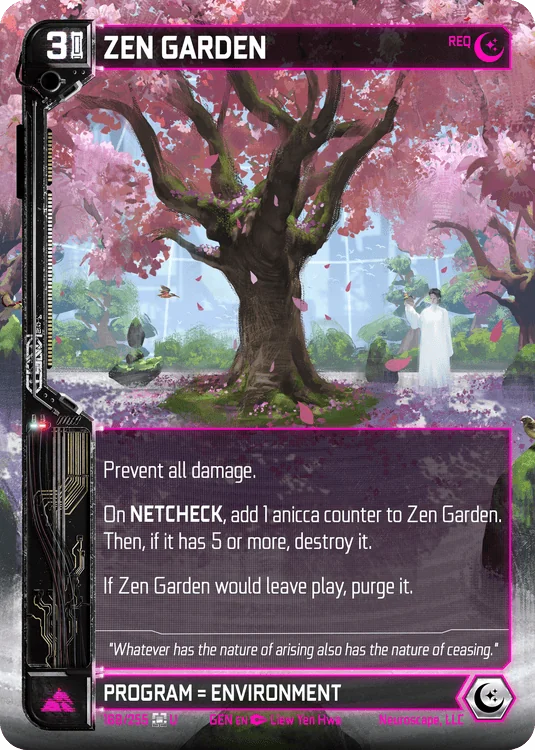
A player wishes to play Beatdown, targeting a character. They are interested in knowing whether Zen Garden will prevent the associated loss of their Bioframe and Mainframe health.
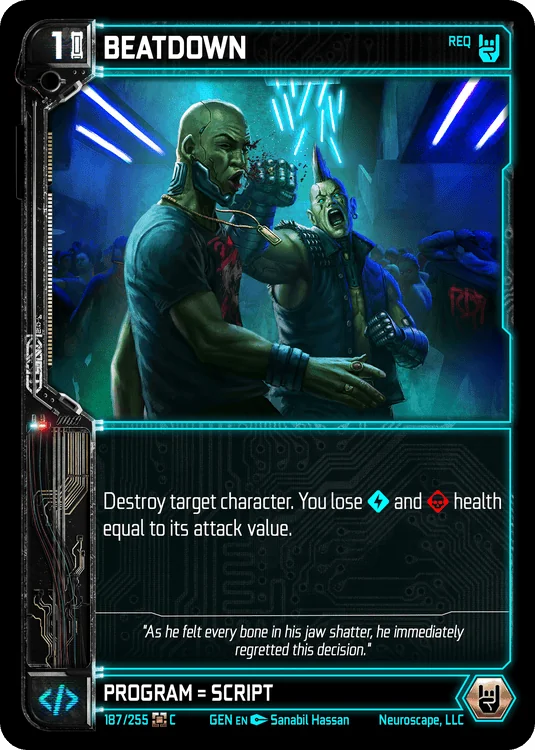
Does Zen Garden allow us to Beatdown characters with impunity?
It does not; while damage causes a loss of health, a loss of health is not necessarily damage.
Beatdown instructs the player to lose health. It does not deal damage to the player. As such, Zen Garden does nothing to prevent this loss of health.
This is a distinction that Magic players will be quite familiar with, although it might not be immediately intuitive to somebody playing their first competitive TCG.
Mainframe, Missing in Action
During a deck check in Round 3 of the Corpo Comeback, we discovered that a player’s Mainframe had not been registered on their decklist.
The default penalty for a decklist infraction in Neuroscape is a Warning. There is, however, a provision for upgrading the penalty:
If the integrity of the game cannot reasonably be restored, the Head Judge may upgrade the penalty to a Game Loss.
I had an opportunity to discuss with Valentyne and we agreed this did not warrant an upgrade.
The particularly important piece of information for me was that the player did not have another Mainframe in their sideboard.
Had the player possessed a second Mainframe in their sideboard, and had that Mainframe also gone unregistered, we would have had a strong argument for advantage because the double omission would have provided an opportunity to alter which Mainframe they were using game one of each match.
Technically, the player could have scouted the room, observed the factions represented, and selected a more favorable Mainframe prior to playing. I don’t believe the theoretical possibility of such an advantage in this particular set of circumstances was sufficient to conclude that tournament integrity had been compromised beyond reasonable repair.
This was also our first Neuroscape event of the weekend, and the tournament software we were using did not facilitate digital decklist submission. Players were required to submit paper decklists.
The circumstances were particularly conducive to an honest omission.
The player received a Warning, the Mainframe was added to the decklist, and the tournament continued.
I think this is a good example of the importance of understanding the philosophy behind a penalty upgrade. We can frequently imagine a way in which an infraction could have been exploited. What we have to assess is whether the actual circumstances provided reasonable potential advantage.
The David Copperfield Clause
A player was resolving the Celestial Visions Swift ability of Searcher of the Sky.
In doing so, the player took the two cards they were looking at, placed them at the end of their hand, and subsequently binned one of them.
The relevant section of the Neuroscape Infraction Manual is:
3.9 Drawing Extra Cards
A player commits Drawing Extra Cards when one or more cards are moved into their hand without authorization.
The default penalty for this infraction is a Warning.
While issuing the Warning was appropriate, the considerably more important part of this interaction was educating the player on how to perform the action correctly in the future.
When an effect instructs us to look at cards and make a selection, we need to keep those cards physically separate from the cards already in our hand.
I sensed a little bit of what I might describe as an internal eye roll on the part of the player. After all, they knew which two cards they had just looked at. Why did it matter that those cards were momentarily positioned with the rest of their hand?
I decided to have a little fun with the explanation.
I explained that the rules have to assume that they are David Copperfield (or, at the very least, that we can’t know that they aren’t David Copperfield). We ask players to perform these actions separately from their hands so that the cards can’t be Houdinied.
The player giggled and responded with something to the effect of, “Yeah, because I look so much like David Copperfield or David Blaine!”
The interaction became a significantly more pleasant one.
It is sometimes difficult for players to appreciate that the procedures we require are largely designed around what we can independently verify, rather than what the individual player knows to have happened.
A little humor can go a long way toward making that distinction understandable.
Redirecting the Unredirectable
Can a player redirect Checkmate with the rather aptly named trojan Redirect?
Nope!
Checkmate does not target.
Having an effect that you would very much like to redirect does not, unfortunately, make it an effect that can be redirected.
Putting the Chariot Before the Horse
One particularly interesting investigation involved the Chariot Tarot.
During Round 1, there was a question between two players as to whether Chariot could be played on another Chariot.
It can.
However, the player being asked the question advised their opponent that it could not be done. In the following round, that same player used Chariot on another Chariot.
This had a bit of a whiff of Cheating to it.
We had a player providing incorrect rules information to an opponent, to their own advantage, and then demonstrating knowledge of the correct rule in the very next round, again to their own advantage.
Of particular importance in this investigation was determining when the player acquired the knowledge that Chariot could be played on another Chariot.
Their use of the card in Round 2 established that they knew how the interaction worked by Round 2. It did not establish that they knew how it worked in Round 1.
In speaking with the original opponent, the head judge and I were able to ferret out a rather important piece of information.
Following their Round 1 match, a spectator had explained to both players that Chariot could, in fact, be played on another Chariot.
Well, that rather neatly explained the discrepancy!
The information we acquired was sufficient for the judge team to conclude that we did not have adequate grounds for a Disqualification for Cheating.
There were additional sensitivities surrounding this investigation. Given those circumstances, and the presence of a Neuroscape, LLC representative at the event, I also discussed the investigation and our ultimate resolution with that representative.
Had the evidence supported a finding of Cheating, the result would have been a Disqualification.
No player’s position within a community should insulate them from tournament policy. Likewise, we should not allow a player’s position within a community to cause us to apply a more burdensome standard to their behavior.
The same evidence and the same policy should lead us to the same conclusion.
Your Opponent Is Not Your Judge
Another important aspect of this situation was that the player who originally received the incorrect rules information was participating in their first-ever live tournament.
They were having an absolute blast!
I subsequently spent some time encouraging them to call a judge whenever they have a question about how something works.
We’re here to help, not to hinder.
There is also the rather practical consideration that your opponent may not always have your best interests at heart. Even a perfectly well-intentioned opponent may be mistaken about how the rules work.
One of the things I would like to see us establish very early in the development of competitive Neuroscape is a culture in which calling a judge is commonplace, comfortable, and entirely devoid of negative social connotations.
Judge, I Object!
We had a young player who made quite good use of the judge staff over the course of the day’s events. And, the vast majority of those interactions were positive and constructive.
On one occasion, following a ruling from Valentyne, the player asked whether she was sure of the ruling.
Valentyne confirmed that she was. Another player also confirmed that the ruling was correct.
“I don’t believe you. Show me where it’s in the rules.”
Valentyne did exactly that.
I subsequently had an opportunity to discuss this interaction with her.
One relevant policy here is:
5.3 Unsporting Conduct — Minor
The NIM identifies disruptive or unpleasant behavior that does not threaten player safety or tournament integrity as potentially falling under this infraction. Examples include excessive profanity, minor disrespect toward opponents, repeated arguing, and unsportsmanlike celebrations.
I don’t necessarily believe that this particular situation would have improved by issuing a penalty, however, it does appear the player may have earned it under the “repeated arguing” guideline. That is a judgement call, and it belongs to the judge who took the call.
The more important conversation I wanted to have with Valentyne was about her authority as Head Judge.
I gave her a somewhat ridiculous hypothetical: if she were to make a ruling that Basic RAMs were not allowed in her tournament, that would be the ruling players were required to abide by.
Doing so would lead to her not being invited to Head Judge another one of our events! But that is the trust we put in our HJs.
The point, however, was that she was the final authority on rulings at that tournament. There was no further appeal available to the player, and compliance with her ruling was not contingent upon her satisfying the player’s demand for proof.
Experienced judges here might use the tactic of:
“This is my ruling. If you would like to explore this more after the round, come find me. I’d be happy to explore with you the Comprehensive Rules. However, right now, I’m going to issue you and your opponent a time extension and get us back to playing Neuroscape.”
Of course, HJ authority comes with a considerable responsibility to make accurate rulings, to exercise good judgement, to consult the appropriate resources, and to remain receptive to the possibility that one might be mistaken. Even so, growing comfort exercising that authority is an important part of developing as a Head Judge.
The Neuroscape Metagame
One of the nice things to come out of the weekend was the subsequent availability of a number of Neuroscape decklists on A-Z Universe thanks to HJ Val.
Card Shark won the Corpo Comeback piloting Berserker, with PrivateProf taking the runner-up position with Gearhead.
Among the seventeen available decklists, there was a fairly interesting variety of factions and archetypes represented.
| Player | Deck | Result |
|---|---|---|
| Card Shark | Berserker | Winner |
| PrivateProf | Gearhead | Runner-Up |
| AzelEdge | Nexus | Top 8 |
| Andy Clodfelter | Nexus | Top 8 |
| ZemoThunderbolt | Berserker | Top 8 |
| Evee | A-Z Luxureon | Top 8 |
| Deandra Jasso | Radiant | |
| KillCrop | Aethernet | |
| Nate Dauterman | Aethernet | |
| Tycen West | Omnis Blood Diamond | |
| Efrem Jasso | Berserker | |
| Benjamin Gailey | Radiant | |
| Wayne Buckhanan | Radiant | |
| RedFalcon | WNDRTECH | |
| BlackDeath | Firestarter | |
| Colin McDonald | A-Z Luxureon | |
| Julio Sanchez | Aethernet |
Two Draws and Two Reddit Threads
As I mentioned at the beginning of this report, my usual definition of a good event is one that stays off Reddit.
We failed twice, both courtesy of Neuroscape!
Is Neuroscape Cooked?
The first Reddit discussion concerned the attendance of our Saturday $1K Corpo Comeback. With nineteen players participating, some were wondering whether the game was already cooked.
Nineteen players for a $1,000 competitive tournament is certainly a number worth examining from the perspective of a tournament organizer. However, an event that meets a minimum is an event that is run to the benefit of all. While there are some outside conditions that made the window for announcing the events tight, I take full responsibility for the numbers and KNOW there are greater things ahead.
Additionally, from my unique vantage point: I can see the number of people being introduced to the game. I can see the first-time tournament participants. I can see the existing players giving their time to teach prospective new players. I can see the interest in becoming judges. I can see whether people are excited about coming to the next event.
A tournament’s attendance figure is certainly an important metric. It is also a single metric representing a particular moment in the development of a game.
We have work to do to grow competitive Neuroscape attendance. What I experienced in Elmhurst left me considerably more enthusiastic about doing that work.
Apparently, We Fixed a Match!
The second Reddit discussion concerned intentional draws.
The eventual winner of the Corpo Comeback had intentionally drawn twice in the Swiss portion of the tournament, advancing to the Top 8 and subsequently winning the event.
The discussion characterized the practice as contrary to the spirit of competition and went so far as to characterize it as match fixing and collusion.
These are particularly unfortunate terms to use, as they have specific meanings under the Neuroscape Infraction Manual and are infractions for which the prescribed penalty is Disqualification.
Intentional draws are permitted under Neuroscape tournament policy.
An additional piece of information worth sharing is that the judge staff were specifically asked whether intentional draws were allowed before the first intentional draw was taken.
We informed the players that they were allowed.
Even had we been incorrect in our interpretation of tournament policy, there would have been considerable difficulty in establishing that a player knowingly violated a policy after receiving explicit authorization from the tournament officials.
As it happens, we were also correct!
The NIM’s Match Fixing provision concerns manipulation of tournament results outside legitimate tournament procedures. An intentional draw expressly permitted under tournament policy is a legitimate tournament procedure.
There is certainly a worthwhile conversation to be had about whether intentional draws should be permitted in competitive TCGs. Magic players have been having that conversation for decades. And, for the record, I’m firmly in the position of the costs of not allowing them greatly outweigh the feel bads of allowing them.
Even if someone disagrees with me, let’s discuss it. However, there is a significant difference between advocating for a change in tournament policy and characterizing a player who follows that policy as having committed a Disqualification-worthy infraction.
Our players should be able to make strategic decisions within the framework of the tournament rules without being accused of Cheating for doing so.
For the Kids
Our Elmhurst weekend also included fundraising efforts for Extra Life.
At the time of writing, our fundraising total is somewhere between $750 and $1,300, with some donations still being reconciled and additional pledged contributions outstanding.
I’m particularly pleased that we were able to incorporate this into our final regular-season weekend, and I appreciate everyone who contributed.
…In Conclusion
The weekend prior to Elmhurst, I was at MagicCon Atlanta.
I’ve been involved with Magic in one capacity or another for more than three decades, and I’ve spent a substantial portion of my adult life participating in, judging, and organizing competitive trading card game events.
Yet, there are quite a few events I attend these days where I feel rather invisible.
MagicCon Atlanta was one of those experiences.
Elmhurst was something quite different.
I had a player ask if they could get a photograph with me, referring to me as “Neuroscape Royalty.”
I don’t think I’ve ever experienced quite that sort of affection from somebody in the Magic community. With some noteworthy exceptions that I will not name, but you know who you are.
Over the course of the weekend, I had the opportunity to teach people a game, introduce people to judging, discuss tournament policy, help a first-time tournament participant feel comfortable calling a judge, and spend time with people who were genuinely excited about building something together.
I felt seen.
More than that, I felt cherished.
As tournament organizers, we are frequently told that something was the best event ever, or that players had an amazing time. I appreciate those sentiments, although I also recognize that people have some emotional investment in feeling good about their decision to have attended an event.
What was particularly meaningful about the Neuroscape community in Elmhurst was the extent to which their enthusiasm was expressed through their actions.
They taught people how to play. They supported each other. They supported our efforts to grow the game. They invested their time and energy in making the experience a better one for the other people in the room.
And at the end of a long weekend of competition, they wanted to take a group photograph together.
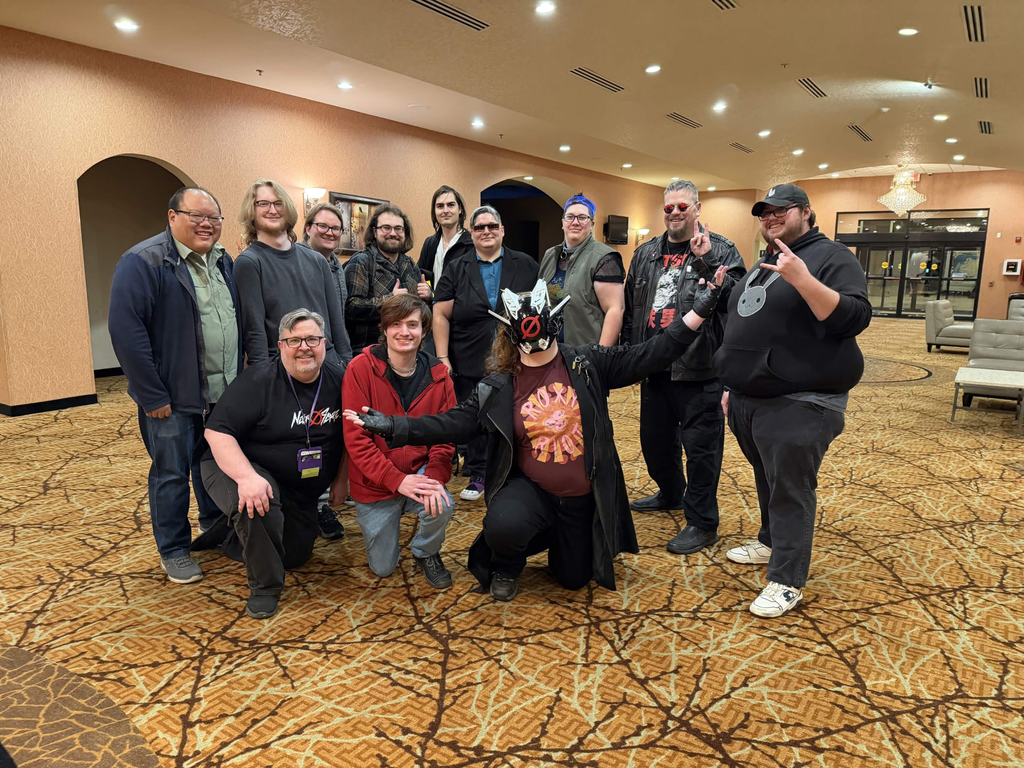
I’ve been thinking about how to describe what these people did for me over the course of the weekend, and the metaphor I keep coming back to is that they performed a little open-heart surgery on me.
The love was real, and the heart was pumping again.
I haven’t had this much fun at an event in over a year.
Thank you, Neuroscape community. I am very much looking forward to seeing you again.
P.S. My goal with this is to provide a tournament organizer’s report that treats organized play as the deliberate cultivation of a community, rather than simply the administration of a competition.
My commitment is to never have NRGEvents.gg be the “McDonald’s” of tournaments, where you know what you’re getting and it’s always mid.
I want your events to be bespoke representations of, and rewards for, your commitment to play, sporting behavior, and care for your comrades in cards.
Leave a Reply