Wizards of the Coast Unveils Its New Magic Judge Program & Somehow Forgets the Judges Who Never Left
By Mark Mason
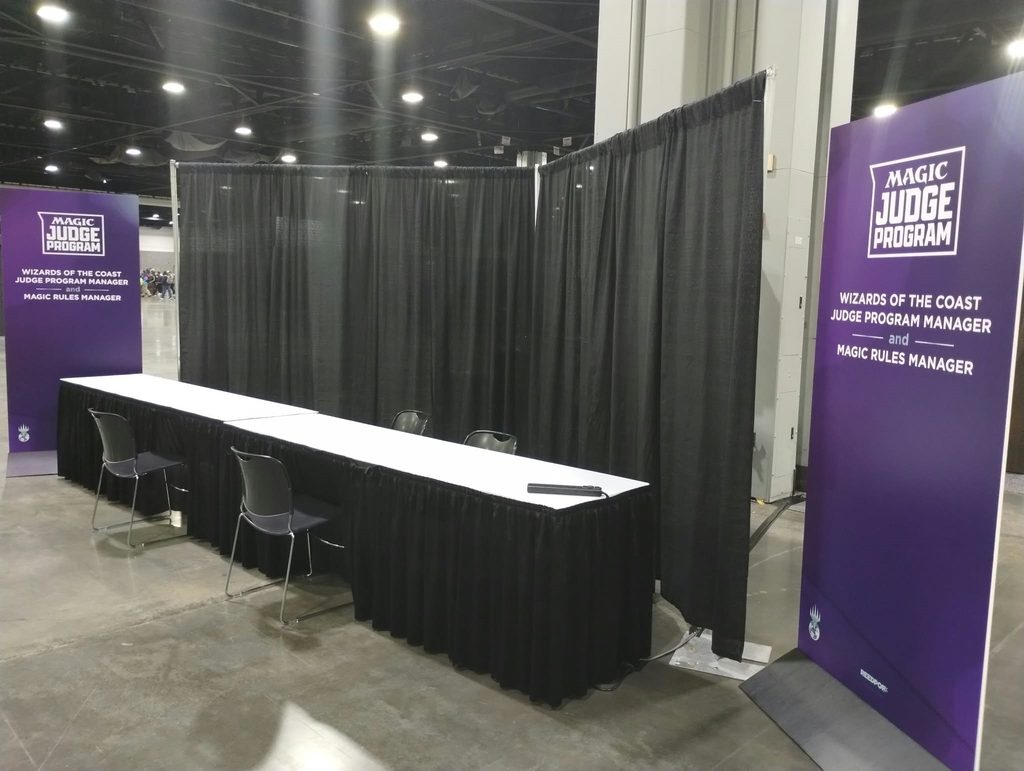
At MagicCon Atlanta, the aspirations for a new Magic Judge Program were shared. The high points included promises of accessibility, international reach, and a streamlined approach to judge education.
There was even a rather handsome leotau named Emjay.
What was conspicuously absent was any acknowledgment that Judge Foundry exists or the many other international groups that supported judges during WotC/Hasbro’s absence.
For those unfamiliar with the recent history of Magic judging, Judge Foundry is the independent organization in the US that championed the work of judge education, certification, and community development following the abandonment of Judge Academy by WotC/Hasbro. Its board members, past and present, were asked to sign nondisclosure agreements in connection with Wizards’ new initiative.
Judging from the presentation, Wizards must have interpreted those NDAs rather expansively. Apparently, even acknowledging Judge Foundry’s existence remained confidential that day.
During the panel’s account of the history of organized judging, neither Judge Foundry nor any of the other international groups were acknowledged. More egregious, not one member of the panel corrected the record when it was suggested that no functioning judge program existed following Judge Academy.
This means the thousands of hours judges have invested in maintaining their communities, educating one another, certifying new judges, and supporting organized play were not merely left unacknowledged but actively erased.
You can announce a return to the game without pretending the varsity team who never quit just doesn’t exist.
The Way It Has to Be
Samantha Harr, presenting the vision for the new program, articulated goals that are genuinely positive: open access, meaningful standards, and the elimination of unnecessary barriers to participation.
These are objectives that many of us in the judge community have advocated for years—including the years of WotC/Hasbro’s silence.
Rather than the familiar hierarchical levels, judges will be able to demonstrate knowledge in particular domains and earn digital badges recognizing those accomplishments after passing a general rules and policy test/s.
There is genuine potential in that approach, especially with it being heavily digital and integrated directly into the Magic Companion app.
But during the presentation, Harr twice used language along the lines of “the way it has to be.”
Perhaps I’m reading too much into a turn of phrase, but I found those moments revealing. They sounded less like a description of an ideal system and more like an acknowledgment of a corporate mandate lacking full transparency.
Of course an investment that can pass a board of directors with one of their billion-dollar brands may govern the actions of the people administering those authorizations.
We’re all family here.
No Questions, Please.
There was another contradiction running through the presentation.
The panel repeatedly emphasized how the judge community produced core friendships, even life partners. The rhetoric was warm, and the examples were heartfelt: We’re all family here.
The presentation itself (less those personal anecdotes) had all the warmth and spontaneity of a corporate earnings call.
While the presentation had been rehearsed, it certainly wasn’t well edited. The carefully curated message, polished talking points, and antiseptic corporate cleanliness could have been a 5-bullet point email. Yet, the panel spoke for an entire hour.
A rehearsed presentation is understandable when announcing a significant initiative.
This contradiction was stark: the panel celebrated the judge community with glowing nostalgia while providing no space for community questions.
For a group resurrecting something so crucial to relationship building, it was stunning to see the entire panel quickly scurry off, many through doors available only to them.
Perhaps the questions would have been inconvenient. Perhaps the schedule simply didn’t permit them. I can only speculate. But even the acknowledgment that one might have questions was unsaid with an invitation to answer puzzles at their open table near the world’s stage to…get a sticker.
No matter the reasoning, a community is not built by telling people how important their voices are and rushing out before they can use them.
The presentation invited you to a family. The format reduced you to an audience.
When Free Isn’t…
The audience was permitted to respond with enthusiastic applause, and at least three such times this happened rather spontaneously; only one of those times was concerning to me.
First, the crowd responded positively to Wizards’ intent to be an international program, with substantial investment in translation and localization.
That is welcome news. Magic is an international game, and one of the frustrations in starting Judge Foundry was the problems of internal law preventing it from meaningfully accommodating judges outside the US and its territories.
The time of applause that I found concerning was when it was emphasized that participation would be free of charge.
Membership fees have remained a source of friction with Judge Foundry growth, particularly because the organization hasn’t done the best job expressing the benefits nor the tangible use of dues, especially when the benefits of certification aren’t equal across all regions or for every level of tournament activity.
But I would suggest we reserve applause until we understand both the business model internally as well as the adoption of Companion App certified judges.
We live in an era in which free digital services can create the appearance of paying less money while turning YOU into the currency through your personal information, behavioral data, privacy, and dependence on proprietary platforms over which you have low to no control.
Wizards may never even monetize judge data, but worthwhile questions are raised when seemingly professional credentials are wrapped into a corporate app.
What information will Wizards collect? Who will have access to it? What happens to a judge’s credentials or history if they lose access to their Wizards account? Will organizers be able to verify qualifications without surrendering their own autonomy to Wizards’ infrastructure?
And perhaps most importantly, what can a judge demand from an organization when the price they pay for membership is free?
In fact, beyond the investment in translation, the non-tangible thing that was put on offer was…digital badges.
The presentation featured digital badges recognizing specialized competencies, such as resolving Un-card interactions or answering lore-related questions.
The badge artwork looked, to my eye, like clip art. Though it was stated these were very preliminary designs. And, if the elegantly rendered leotau mascot (Emjay) is any indication of the final product, it’s premature to judge them by the displayed samples.
So, while it was cool to learn there might be a “Stack” badge with a lightning bolt emoji on it, I hope Emjay will soon tell us what qualifies someone to judge a competitive Magic tournament.
A digital badge may tell me that someone passed a test about layers. It cannot tell me whether that person can calm an angry player, mentor an enthusiastic floor judge, recognize when an investigation is necessary, or exercise judgment under pressure.
Those skills simply do not lend themselves to multiple-choice questions.
Announcements,
Announcements,
Announcements…
Perhaps the most surprising applause came when the panel revealed that the new program could be available online as early as spring 2027.
Spring. Of next year.
So Wizards has once again begun the process of announcing announcements.
To be fair, building an international certification platform, translating educational materials, establishing competency frameworks, and integrating everything into Companion is substantial work.
But a projected launch window is not a functioning program. And, even so, some of our international support communities have already shut down in anticipation.
For judges currently educating, mentoring, and certifying other judges, the announcement raises an obvious question:
What exactly are we supposed to do between now and then?
Presumably, what we’ve been doing all along.
Only now, perhaps, with even greater invisibility.
What Wizards Should Be Doing
There is an important positive development here, particularly for Judge Foundry.
Wizards appears prepared to assume responsibility for two of the most resource-intensive functions of a judge organization: education and testing.
That could be genuinely beneficial. Maintaining an SAT-like testing organization—one that develops educational materials, keeps examinations current, translates content, and administers tests—requires significant ongoing labor
Historically, much of that labor has been performed by volunteers also paying membership dues.
If Wizards wants to fund that infrastructure, excellent.
But education and testing are not the entirety of a judge program. The SAT is neither the diploma you earn nor the crucial experience you develop, even if it helped you gain admission.
Absent in the presentation, except in nostalgic memories: Mentorship.
For all the panel’s discussion of friendships, professional connections, and the importance of the judge community, there was remarkably little explanation of how those relationships would be cultivated through the proposed system.
Perhaps that is because they won’t be.
A digital platform can distribute educational materials. It can administer examinations. It can track demonstrated competencies and display your badges.
What it cannot easily do is replace the experienced judge who takes a new judge aside after a difficult ruling, explains what went wrong, and helps them develop the wisdom and confidence to do better next time.
It cannot recreate the relationships built over long tournament weekends, judge meals, or the networks of mutual aid that have sustained organized play through multiple institutional transitions (including WotC’s own hand selected Judge Academy which launched Oct 1, 2019 and had its partnership abruptly ended almost exactly 4 years later on Oct 13, 2023).
And perhaps that is precisely why and where Judge Foundry should concentrate its future efforts.
If Wizards is going to shoulder the burden of education and testing, an independent organization can focus on what corporate, digital infrastructures are illequipped to provide: authentic community, personal mentorship, professional development, and judging opportunities that exist independently of Wizards’ permission.
I submit that this would be a meaningful division of labor.
It might even be a healthy one for as long as WotC continues to deliver.
Trust Me, I’ve Got a Badge
The new program was described, in part, as a means of giving players confidence in judges.
As someone who was a Rules Advisor until WotC ended that program, and who has judged Magic for over a decade since, I find that claim worth examining.
Confidence in what, precisely?
A credential may indicate that someone has demonstrated a defined body of knowledge. But players generally do not have the opportunity to evaluate a judge’s qualifications independently, nor do they necessarily understand the significance of a particular certification.
They develop confidence through experience: consistent rulings, clear communication, professionalism, fairness, and the knowledge that judges are accountable to meaningful standards.
You don’t have to ask too many competitive players to tell you about a certified (sometimes high level) judge they don’t trust for reasons.
Taking Power, No Spark
The most striking aspect of Wizards’ announcement was not what the company intends to build.
It was what the presentation suggested: Wizards believes it is entitled to reclaim what you built absent them.
For years, organized judging has existed in a complicated relationship with Wizards of the Coast. Judges have been essential to the success of competitive Magic while repeatedly navigating changes in institutional support, certification structures, and the boundaries of their relationship with the game’s publisher.
Judge Academy came and went.
Judge Foundry and others emerged.
And judges kept making magic for players world-wide.
Now Wizards returns with a corporate platform, a collection of digital badges, and a presentation that somehow manages to discuss the history of judge certification without acknowledging the organization currently doing the work.
I welcome Wizards investing in education. I welcome translation. I welcome accessible testing, reduced financial barriers, and a more flexible approach to demonstrating expertise.
Those are worthwhile goals.
But I shall not equate corporate ownership of certification infrastructure with stewardship of a professional community.
Nor should anyone assume that the assumption of power to issue digital credentials is equivalent to the ability to cultivate good judges.
The spark of organized judging has never resided in a logo, a level, or an examination.
It has resided in you, all of you judges and support members: your expertise, your relationships, your willingness to teach, and your commitment to making events better for everyone who participates even during the most uncertain times.
Wizards may be claiming the power to certify.
But the spark simply isn’t theirs to take.